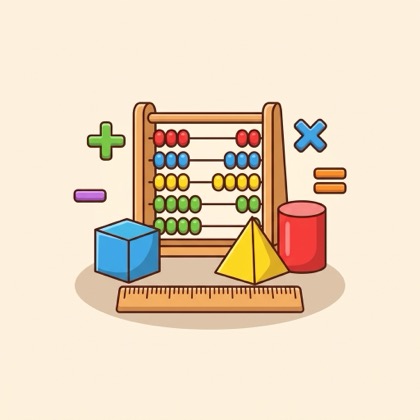
Mathematics
631 lessons
Number and place value, the four operations, fractions and decimals, measurement, money, shape and geometry, data handling, and the word problems that decide the PLE.
About Kioo
Kioo is Swahili for mirror. The idea is simple: an app that reflects a child's own growth back at them — what they've learned, what they've mastered, and what's still worth another ten minutes.
3,151
Lessons
Each with its own illustration
9,451
Quiz questions
Tied to specific lessons
171
Animations
For concepts that move
100%
Illustrated
Not one stock photo
Complete coverage of Primary 1 through Primary 7, built on Uganda's Competency-Based Curriculum — around 450 lessons per class level.
631 lessons
Number and place value, the four operations, fractions and decimals, measurement, money, shape and geometry, data handling, and the word problems that decide the PLE.
630 lessons
Phonics and early reading, vocabulary, grammar and sentence building, punctuation, comprehension, and composition that gets to the point.
630 lessons
Living things, the human body, health and hygiene, plants and crops, animals, matter and energy, weather, soil, and the environment around a Ugandan home.
630 lessons
Family and community, our district and country, the physical and human geography of Uganda and East Africa, history, government and civic life.
630 lessons
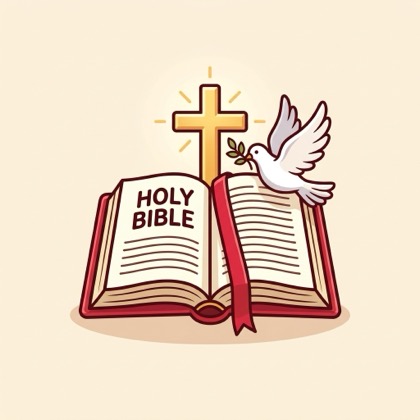
Christian and Islamic Religious Education — stories, parables, values, and the everyday questions of honesty, gratitude and forgiveness.
Alongside the core five, the catalogue includes Literacy, Reading, Writing, ICT, Luganda, Runyankore/Rukiga, Thematic Learning, Art, Physical Education and more — 18 subject areas in total.
One idea per lesson
Two to five minutes of reading. Not a chapter — a single concept a child can hold in their head.
Its own illustration
Every one of the 3,151 lessons has a hand-drawn banner made for that lesson. No stock photography anywhere in the app.
Motion where it helps
171 lessons carry an animation — the water cycle, cell division, orbits, germination. Things that are genuinely hard to grasp from a still picture.
A quiz that proves it
Every lesson ends in questions. 70% marks the topic complete; 100% marks it mastered. We keep your best score, so retaking can only help.
The look
Most educational apps a Ugandan child can download were drawn somewhere else. The playgrounds are wrong, the uniforms are wrong, the food is wrong, and the children on the page don't look like the child holding the phone.
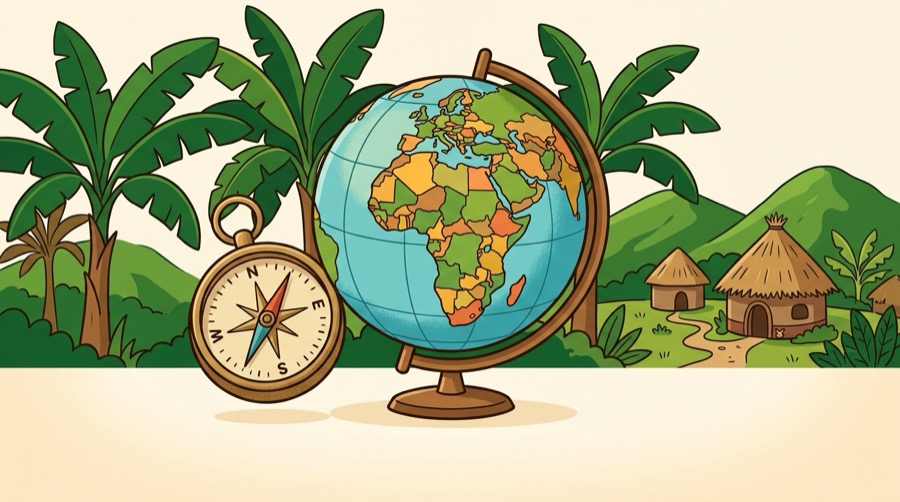
So we drew all of it ourselves: 3,151 lesson banners and 18 subject banners in one consistent illustrated schoolbook style — bold outlines, flat warm colour, and East African context wherever people, places or animals appear. School uniforms. Banana groves. Ankole cattle. Crested cranes. Matooke.
Consistency across the whole library is our first quality metric. Every banner should feel like it came out of the same book.
The complete P1–P7 library, quizzes, read-aloud, search, the Parent Portal and the AI Homework Tutor, running on Android today.
An iPhone build is the immediate next step, with the same content and the same free tier.
Bulk seats and class dashboards for schools and tutoring centres, then curriculum coverage for Kenya, Tanzania and Rwanda.
Kioo is built by Kioo Education, a small team in Kampala — writers, illustrators and engineers working on one product. We are not a publisher with an app on the side.
If you're a teacher who has spotted an error, a school that wants seats, or a parent with an opinion, we would rather hear it than not: support@kioo.site.